
Overdub is a music studio in the browser for you and your AI agents. Hum, tap, play or say it: the agent turns musical language into notes, sounds and settings, and builds instruments and effects that didn’t exist until you described them. Every edit is signed by its author. It never generates audio.
For the press.
Musicians describe music in pictures: “make it warmer”, “the bit that goes da-da-DUM”. Software wants numbers. For years AJ Smith, a musician and computer scientist, has been the person in the middle, turning friends’ ideas into notes, plugins and knob positions. Overdub puts an AI agent in that chair. It is a music studio in the browser: you hum, tap, play or say a take, and your agent plays over it with notes, settings, and instruments and effects it writes as code, which the studio tests before anyone hears them. Takes go into the song in time, after a count-in, and any knob can be drawn or recorded as automation. Agents can’t hear, so the studio measures the mix for them. Every edit is signed, warm for you and cool for the agent, and the agent’s can be undone without touching yours. Overdub never generates audio.
Three lengths to copy.
Overdub is a music studio in the browser for a musician and their AI agents. Musicians describe music in pictures (“make it warmer”); DAWs want numbers. Overdub puts an agent in the translator’s chair and keeps the musician in control. Hum, tap, play or describe an idea, and the agent writes notes, adjusts settings, and can write new instruments and effects as code, which the studio tests before anyone hears them. Because agents can’t hear, the studio measures the mix for them. Every edit is signed, human or agent, and can be undone. Overdub never generates audio. It is free and runs in your browser.
Overdub is a music studio in the browser, built for a musician and their AI agents to make music together.
Musicians describe music in pictures: “make it warmer”, “the bit that goes da-da-DUM”. Software wants numbers. Between the two there has usually been a person who translates. Overdub’s maker, AJ Smith, a musician and computer scientist, has been that person for years. Overdub puts an AI agent in that chair and keeps the musician’s hands on the song.
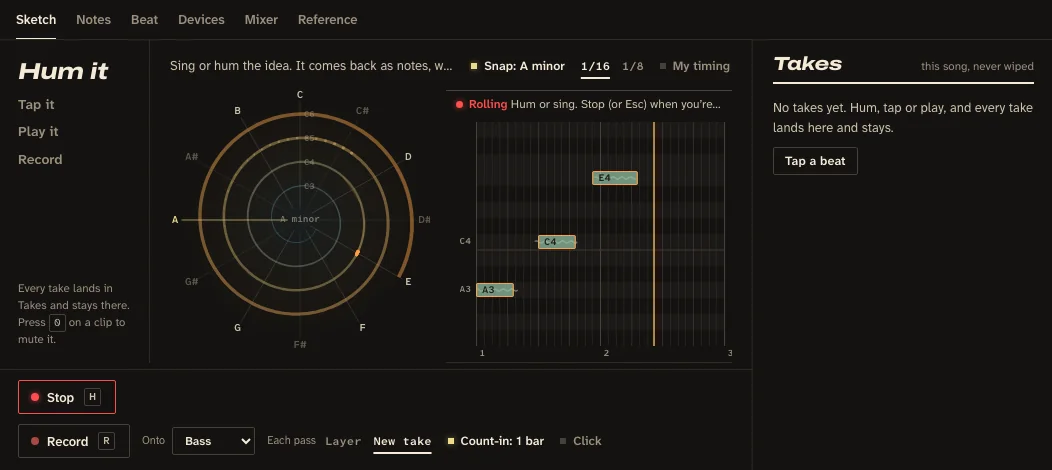
There are four ways in. Hum, and pitch tracking writes the notes. Tap, and the groove lands on a drum grid. Play a guitar, a MIDI keyboard or the computer keys. Press record first and the take lands in the song after a count-in, every pass kept. Or say what you want, and the agent changes what is already there and shows exactly what it moved. Ask for an effect that doesn’t exist and the agent writes it as code; the studio tests it before it plays, then gives it a face with real knobs.
Agents can’t hear, so the studio measures for them, reporting loudness, peaks, spectrum and key in musicians’ terms. Every edit records who made it, so the agent’s work can be undone without touching the musician’s.
Overdub never generates audio: everything is notes, parameters and code. It grows out of the Guitar Studio in AJ’s browser punk-song maker Claw’d-o-Matic, whose 101 pedals, 27 amps and 156 rigs it includes. Outside agents such as Claude Code connect over MCP. Overdub is an early prototype, free, and runs in your browser.
The numbers are counts.
- Built-in devices
- 23
- Agent-built devices
- 13
- Pedals
- 101
- Amps
- 27
- Rigs
- 156
- Agent tools
- 38
- Name
- Overdub. Overdub Studio on first mention or where it needs to be found. Sentence case in prose; “overdub” in lower case in the wordmark. Never “OverDub”.
- Lines
- Play over each other. A studio for you and your agents.
- What it is
- A music studio (a DAW) in the browser, built for a musician and their AI agents.
- Status
- Early prototype, live since 30 September 2026. There are no user numbers to report yet.
- Web
- overdubstudio.com (this site) and overdubstudio.com/app/ (the studio)
- Price
- Free. The in-studio agent uses the musician’s own Anthropic API key, billed by Anthropic; a demo agent runs without one.
- Platform
- Any current browser (Chrome, Edge, Safari, Firefox), on a computer or a phone. No install, no account. Web MIDI needs Chrome, Edge or Firefox.
- Made by
- AJ Smith
- Built-in instruments and effects
- 23, all synthesized in the page: 13 instruments and 10 effects, named after things in a studio (Patch Bay, Capstan, Stairwell, Echo Reel…).
- From the Guitar Studio
- 101 pedals, 27 amps, 16 cabinets, 5 mics and 156 rigs, from AJ’s Claw’d-o-Matic, each rig leveled by measurement.
- Agent tools
- 38, shared by the agent in the studio and by outside agents over MCP.
- Agent-built devices
- 13 ship with it: 10 on the house shelf in the device library and 3 in Night Shift, each carrying the request that asked for it.
- Ways in
- Hum (pitch tracking), tap (to a drum grid), guitar or bass through an audio interface, MIDI keyboards, the computer keyboard, and words to the agent.
- Recording
- Into the song from a start marker, after a count-in of one or two bars, with a metronome you can see. Round a loop, drum passes layer into one clip and other passes stack as takes.
- Automation
- Lanes for level, pan and any knob: drawn, recorded from a knob as it turns, or written by the agent. They play the same live, in an export and in a render.
- Demo songs
- 10, each in a different genre, from lo-fi to bossa nova. Each has a part signed by Claude, written ahead of time like the rest.
- What it measures
- Integrated loudness (LUFS), true peak, crest, band energy, brightness, stereo width, onsets, key and a spectrogram.
- Agents
- Claude in the studio (Opus 5.5, Sonnet 5.5 or Haiku 4.5, with the musician’s key); Claude Code and other MCP clients from outside, connected to a local copy of the studio.
- Generated audio
- None. Every sound is synthesized from notes, parameters and code.
- Your song
- Saved in your browser. No account.
- Privacy
- No account. On the live site, anonymous counts only (page views, and in the studio opens, plays, agent messages, devices, exports, shares, hums and keeps): no cookies, no ids, never the song. Do Not Track and Global Privacy Control turn them off. The in-studio agent talks straight to Anthropic with the musician’s key.
- Code
- Plain JavaScript modules: no build step, no dependencies.
Counts come from the code as it runs today, not from a plan.
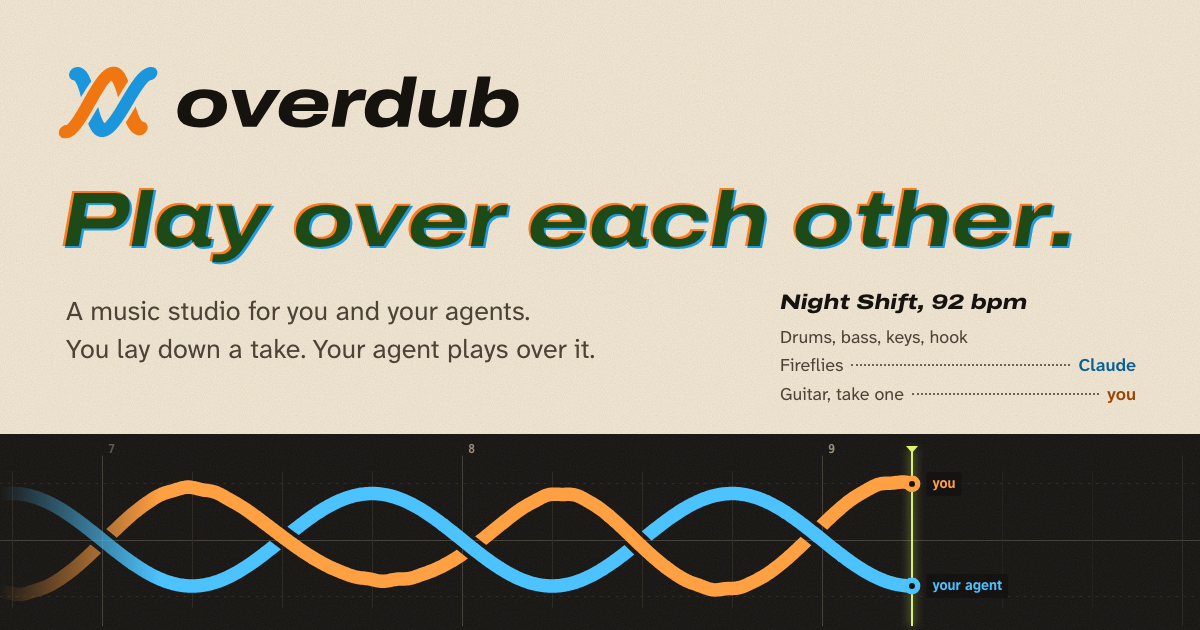
The Weave and the wordmark.
Two strands cross twice. At the first crossing the warm one (you) is on top; at the second, the cool one (your agent) is. All four files are vectors.




Colours
- Graphite
#141210 - Cream
#f4ead6 - Leader green
#d9f36a - Grease pencil
#f1dc8a - Warm: a person
#ffa043 - Cool: an agent
#4cc3ff
Please don’t
- Recolour the strands. Warm is always the person, cool is always the agent.
- Swap which strand is on top at the first crossing, add a third, or straighten the wobble.
- Outline it, add a shadow, or set it on a busy photo.
Type: Archivo at its widest, ExtraBold Italic, for display; Atkinson Hyperlegible Next and Mono for everything else. All free on Google Fonts.
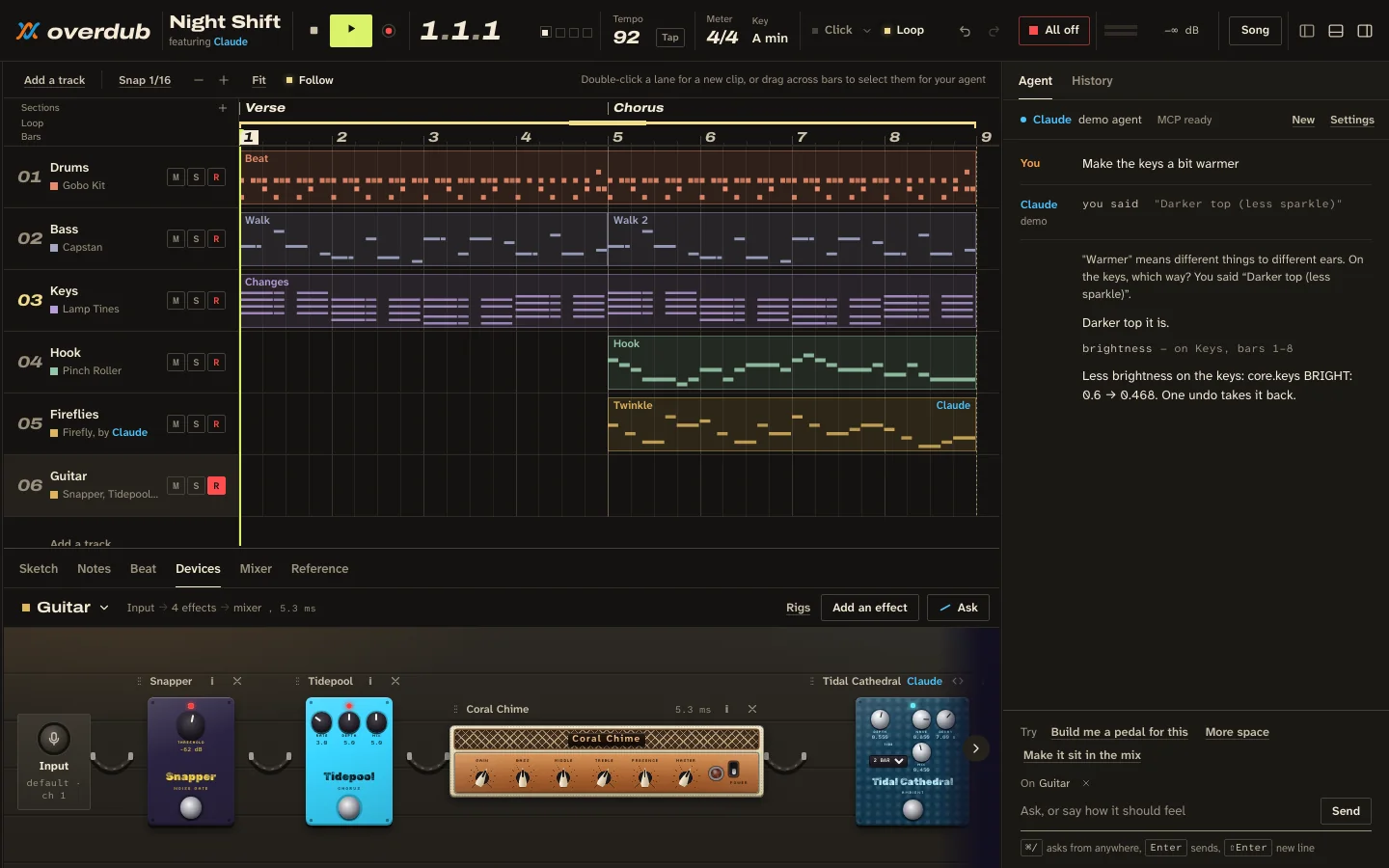
Screenshots of the studio as it runs.
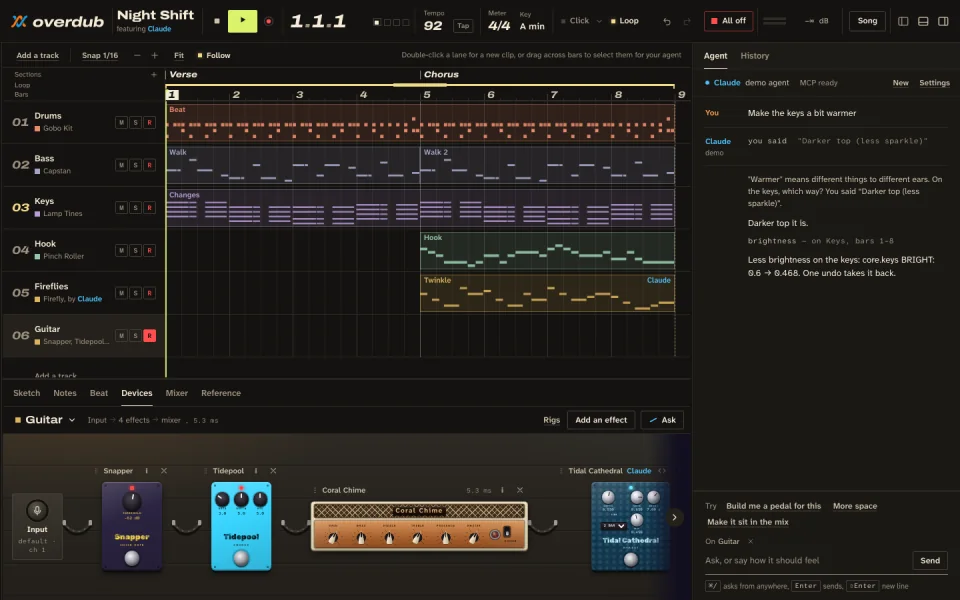
Each picture is the studio as it runs today, open on Night Shift, the first of the ten songs it ships with. The captions say what is on screen.


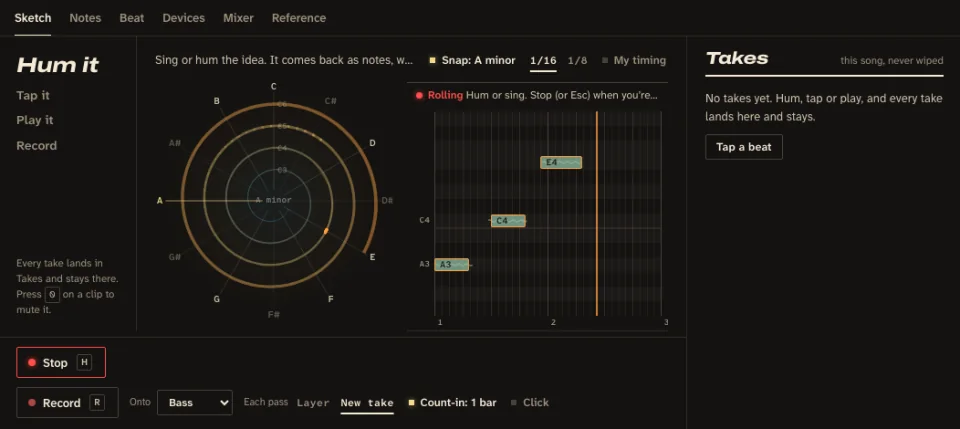
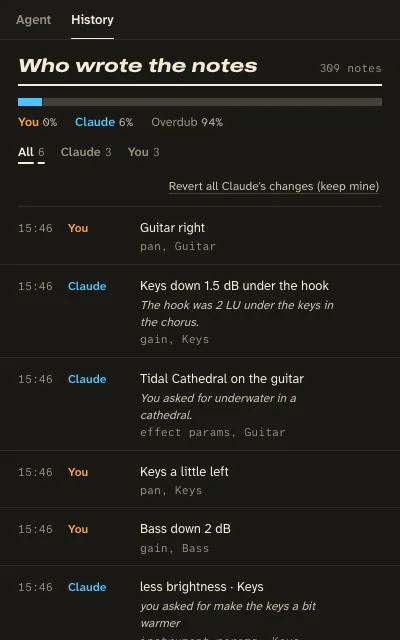
Thirty seconds of the studio.
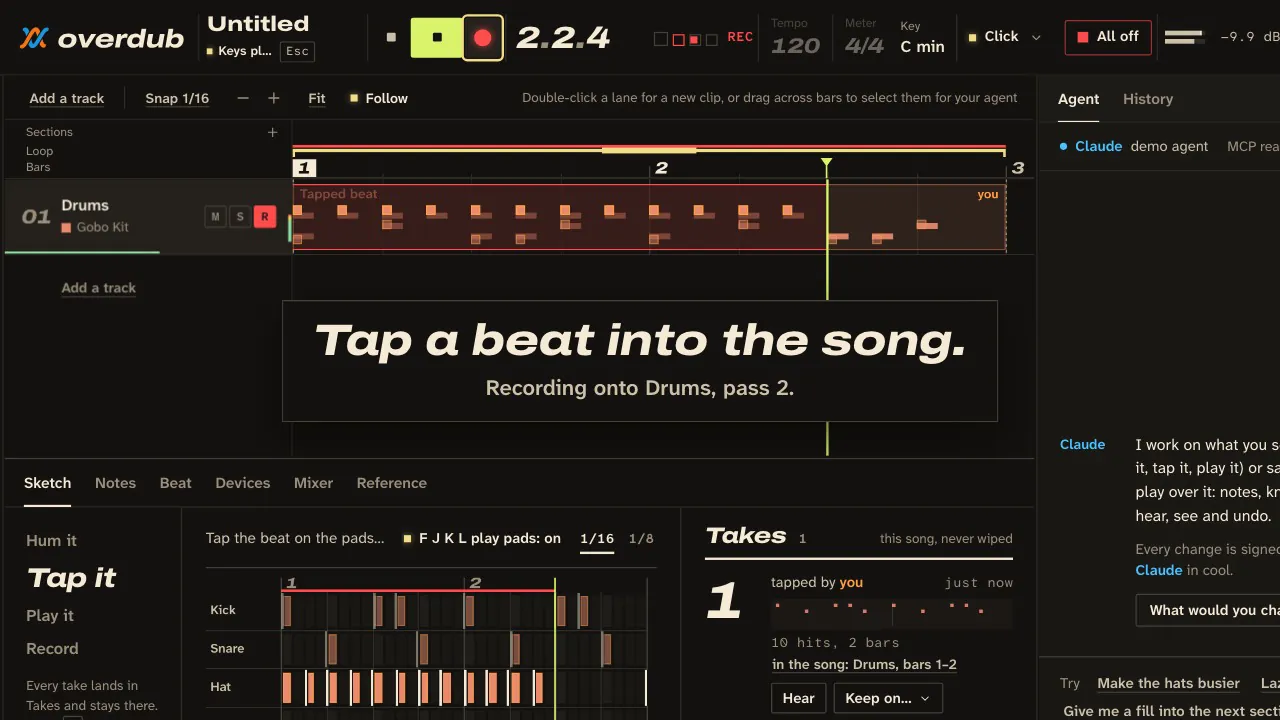
It plays on your song.
- Call ita studio for you and your agents, or a browser DAW with an AI agent built in.
- Please don’t call itan “AI music generator”. It never generates audio, and the musician makes the song.
- What the agent doesIt writes, suggests, builds or tidies. It doesn’t “create your song”.
AJ Smith.
Overdub is made by AJ Smith, working with Claude. The code is open, under MIT, at github.com/aj-dev-smith/overdub.
Overdub StudioPress


Get in touch.
Write to aj.dev.smith@gmail.com.
To try it first, open the studio: it runs in your browser with nothing to install, and the demo agent works without a key.